
HelioAI: Research Portal
The HelioAI research portal is a collaborative space for sharing of datasets, models, code repositories, live notebooks, and other heliophysics RADIANT research outputs.
HelioAI.org is committed to scientific excellence, open data, and AI-driven discovery, working in collaboration with academic institutions, government agencies, and industry partners to push the boundaries of heliophysics research in the spirit of open science.
The RADIANT program (Research and Development of Initiatives using Advanced New Technologies) is a newly formulated program of NASA heliophysics.
Welcome to HelioAI
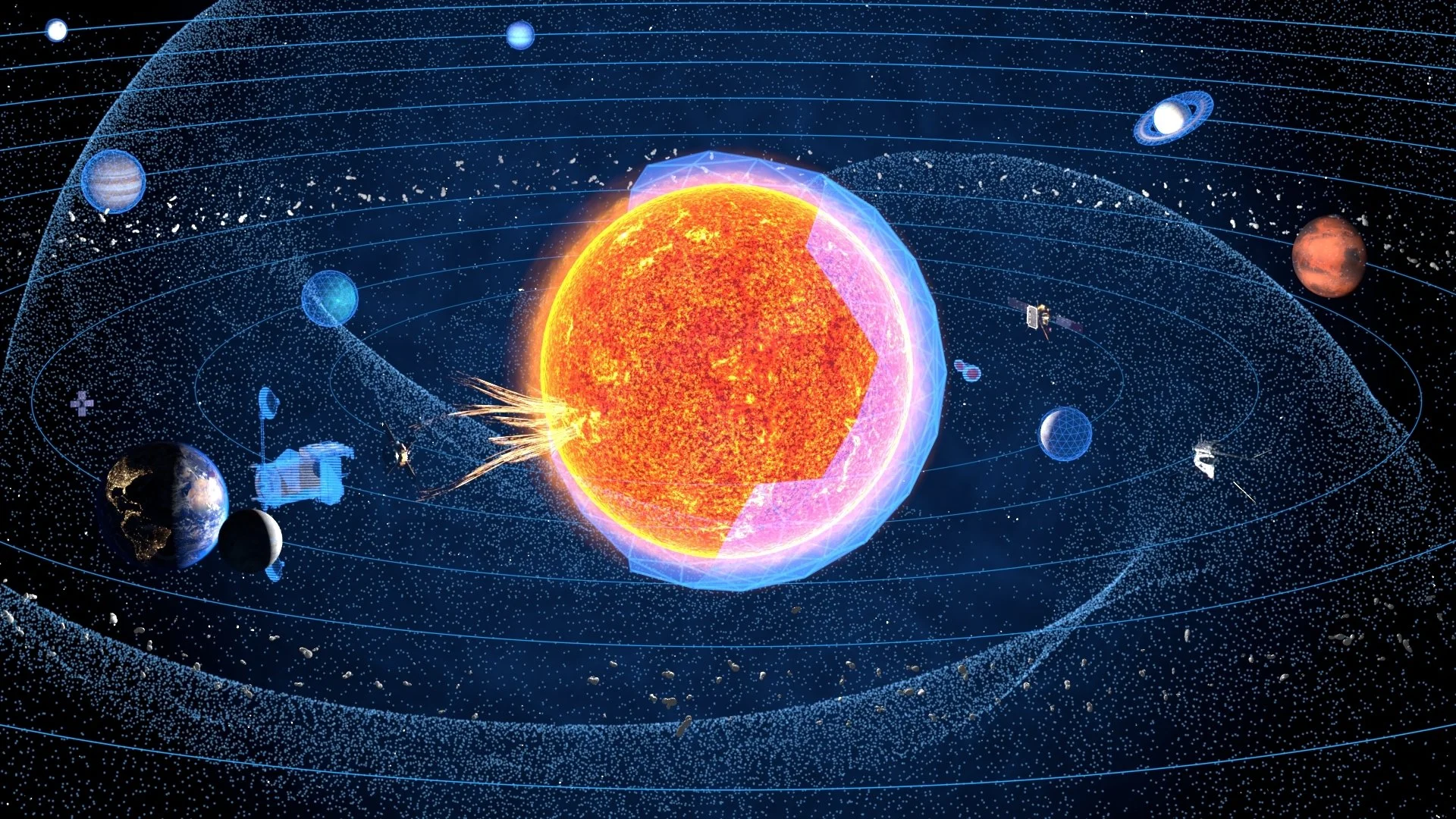
Artificial Intelligence is transforming the way we understand the Sun’s behavior and its impact on Earth and beyond by building a coherent “full picture” of the Sun and its interactions.
You’re invited to become part of our community of heliophysicists and data scientists pushing the boundaries of what is possible.
Goal
The goal is to build a comprehensive catalog that highlights the impact of your work and makes it easier for the scientific community to discover and cite your outputs. By hosting this data in a single portal, we aim to ensure that all research funded by NASA is easily accessible and correctly attributed.
You must login to have access to share or download datasets, models, code repositories and othe research outputs.

Log in

Upload

Download
Core research themes
As humanity sets its sights on Mars and beyond, the need for accurate solar and space weather predictions has never been greater. RADIANT is committed to harnessing AI to bridge the gaps in our understanding of Earth-Sun interactions. Our innovations not only protect astronauts and satellites but also ensure that as we explore the cosmos, we do so with safety and scientific excellence at the forefront.
Our research spans:
Solar Activity Prediction
AI-powered models for forecasting solar flares, coronal mass ejections (CMEs), and other space weather events.
Multi-Modal Data Integration
Combining satellite observations, magnetograms, and historical solar data to create more comprehensive predictive models.
Physics-Informed twins
Developing AI systems that incorporate fundamental heliophysical principles to improve interpretability and reliability.
Computational Engines
Enabling real-time onboard AI for anomaly detection, adaptive mission planning, and space weather monitoring.
Earth-Sun Interactions
Understanding the Sun’s role in long-term climate variability and extreme weather events.